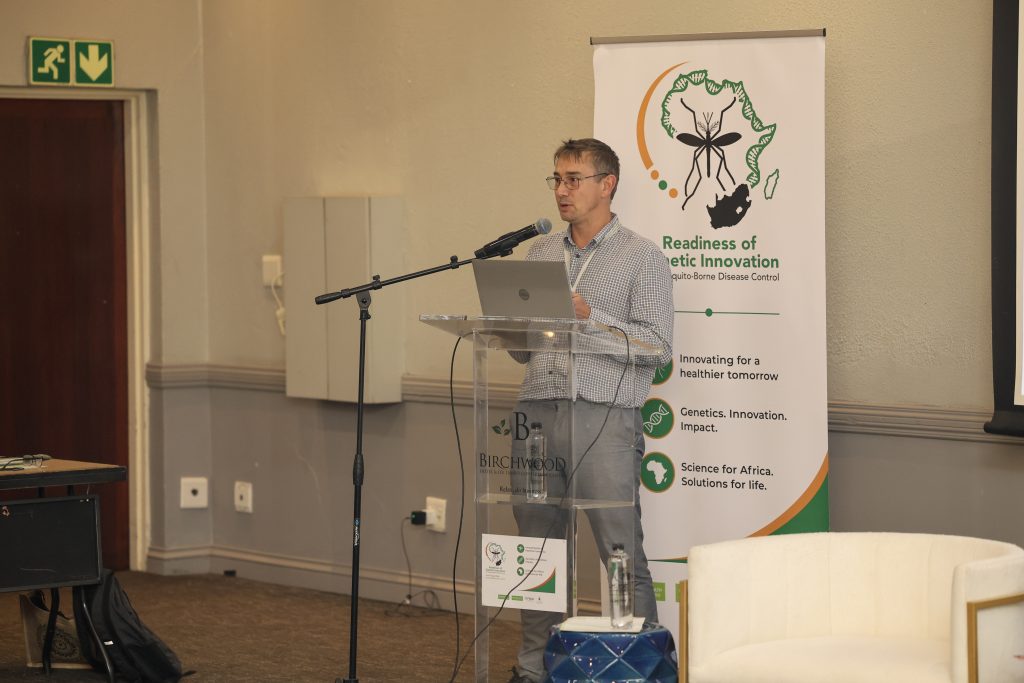
Malaria Control gains in Africa are slowly being reversed. In 2024 alone, malaria claimed approximately 600 000 lives, mainly because of growing insecticide resistance, mosquitoes that have adapted to biting and resting outdoors, and a vector control toolbox that has is limited. To address these challenges, the National Institute for Communicable Diseases (NICD) in partnership with the Wits University Research Institute for Malaria (WRIM), have convened an international workshop from 24 to 27 August 2026 in Johannesburg to prepare a pathway for field development of next-generation genetic-based mosquito control approaches.
The workshop, which brings together around 25 scientists, industry developers, regulators, and international partners, builds on progress that South Africa has made in developing the sterile insect technique (SIT), in which male mosquitoes are reared in the laboratory, sterilised and released by the thousands to mate with wild females, whose eggs then will never hatch. Since the first sterile male releases in Jozini, KwaZulu-Natal, in 2021, the South African SIT programme has advanced the technology. The lessons learned along the way, from mass-rearing to long-distance transportation to community engagement, are proving to be the foundation for adaptation to other new innovative tools such as gene drive technology.
The gene drive technology – in contrast to SIT, which makes male mosquitoes unable to father offspring – provides a genetic change a head start: instead of being inherited by only half of a mosquito’s offspring as normal genes are, a gene drive is passed on to nearly all of them. Released in small numbers, it can spread through a wild population over generations, offering a self-sustaining tool that needs far fewer repeat releases than SIT. “The two technologies share the same starting point,” explains Dr Givemore Munhenga, Principal Medical Scientist in the Vector Control Reference Laboratory at NICD’s Centre for Emerging Zoonotic and Parasitic Diseases. “Before any genetically modified mosquito can help fight malaria, someone still has to rear it by the hundreds of thousands, package it safely, transport it, and release it in the field. That is exactly where our SIT experience becomes so valuable.”
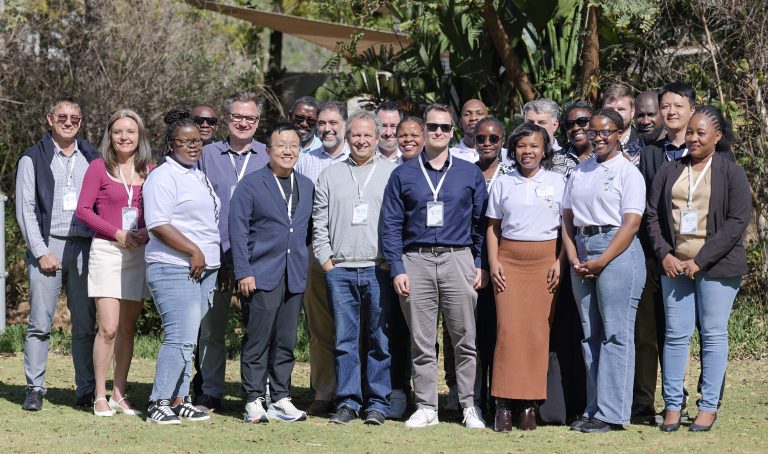
The workshop, jointly convened with the USA Foundation for the National Institutes of Health (FNIH) and supported by the Bill & Melinda Gates Foundation, focuses on three practical questions: What are the biggest technical challenges in mass-rearing, handling, transporting and releasing genetically modified mosquitoes? Which of these steps can realistically be automated? And should production happen locally, country by country, or regionally, with mosquitoes shipped across borders to where they are needed? Delegates included gene drive researchers, companies developing mosquito-rearing automation, and oversight bodies such as the International Atomic Energy Agency and New Partnership for Africa’s Development. “Gene drives have shown enormous promise in caged trials, but very few groups have grappled with what it actually takes to move from the laboratory to the field,” emphasised Dr Munhenga. “That is our expertise. This workshop lets us share it, learn from others working on the same problem, and make sure that when these tools are ready, Africa is ready to deploy them.”
By the end of the week, the workshop aims to produce an understanding of technical needs and knowledge gaps, new collaborations between NICD and gene drive developers and implementers, and a refined roadmap for the Institute’s own upscaling of the SIT project, another step towards putting a self-sustaining tool in the hands of malaria control programmes in South Africa and across the continent.
The workshop launches alongside a new three-year NICD project to upscale the deployment of genetic control approaches against Anopheles, South Africa’s primary malaria-carrying mosquito. The project will refine mass-rearing and sexing automation, test long-distance chilled transport, trial both ground and drone-based releases, and strengthen the regulatory pathways needed before any gene-drive mosquito can be released in the field.