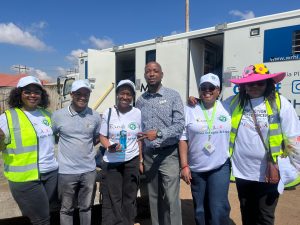

The South African Consortium for Advanced Research Training in Africa, together with the National Cancer Registry (NCR) housed within the National Institute for Communicable Diseases (NICD), led a community cancer awareness activation at Oakmoor Taxi Rank in Tembisa, Johannesburg, in September.
The activation brought together local road traffic services, community health workers, Wits Infectious Diseases and Oncology Research Institute, the Tembisa Hospital NHLS laboratory, and other partners, with support from the Democratic Nursing Organisation of South Africa, the NICD, and the Ekurhuleni Health District. The Wits Reproductive Health and HIV Institute and Ekurhuleni Health District provided fully equipped mobile clinics, clinical materials, and staff. As hosts, the Tembisa Local Taxi Association provided essential on-site support, including sanitary facilities, security, and mobilisation of taxi operators.
The awareness drive, which was organised by NCR began with a community walk, where engagement and information were shared with community members. The awareness drive connected commuters, taxi drivers, and residents and shared information about cancer screening and referral support.
Public engagement continued throughout the day through health talks and one-on-one discussions covering cancer warning signs, the importance of early healthcare-seeking, and screening. About 100 people accessed one or more health-screening services, including blood pressure and blood glucose checks. Additional services included prostate-specific antigen (PSA) blood draws, pap smears, HIV screening, and family-planning services.
The awareness drive led to further collaboration between cancer surveillance, research, healthcare, and community partners. The strength of these connections was evident when the team was invited to take part in another community walk in Tembisa in September, extending the engagement beyond the original activation.
By taking cancer information and screening services into a busy community setting, the activation made these resources more accessible to people where they live, work, and travel. It showed how bringing research, surveillance, healthcare services, and community partners together can turn cancer awareness into meaningful, practical engagement.