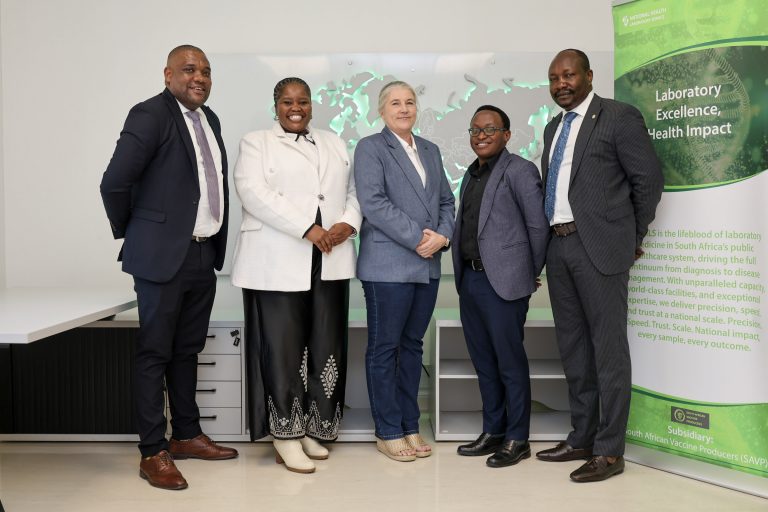
The National Institute for Communicable Diseases (NICD) has been earmarked as one of the institutions to participate in the Africa Centres for Disease Control and Prevention (Africa CDC) Laboratory Leadership Fellowship programme. The initiative aims to strengthen leadership capacity and empower laboratory professionals across the continent.
Speaking during a visit to the NICD, the head of the Africa CDC delegation, Dr Donewell Bangure, highlighted the need for a leadership programme tailored to Africa’s unique challenges.
“Existing global leadership programmes rarely address Africa’s unique operational, financial and systemic realities,” he said, adding that the NICD had been identified because of its strong institutional expertise. NICD Acting Executive Director, Prof Nicola Page, welcomed the initiative, highlighting the importance of strong leadership in laboratory systems.
“Strong laboratory systems depend on people who can lead teams, manage resources, build partnerships and translate scientific evidence into public health action. This fellowship offers an opportunity to develop those capabilities through practical experience and mentorship,” she said.
As part of the programme, selected fellows will be placed at public health institutes across the continent for practical training and mentorship. The NICD has been identified as a potential host institution and will also have an opportunity to nominate a staff member to participate in the fellowship.
The programme will focus on eight key competencies, including strategic leadership, research and development, communication management, human resources, surveillance, laboratory networks and emergency response, programme and project management, financial management, and quality management systems.
The fellowship targets mid-level laboratory managers and supervisors working in national public health, reference and clinical laboratories, as well as professionals from ministries of health, research institutions and laboratory networks. It aims to equip emerging laboratory leaders with the skills and experience needed to take on greater leadership responsibilities.
According to Africa CDC, approximately 70% of clinical decisions globally rely on laboratory test results, underscoring the critical role laboratories play in patient care, disease surveillance and health security. Strengthening laboratory leadership is therefore essential to building resilient public health systems across Africa.